


Reach, frequency and VAC. We assist you in understanding and applying key performance indicators to ensure your outdoor campaign achieves maximum impact. By leveraging the unique strengths of the medium, optimizing creative content, and integrating outdoor advertising with your other channels, we create the conditions to maximize both reach and effectiveness.


-
 1
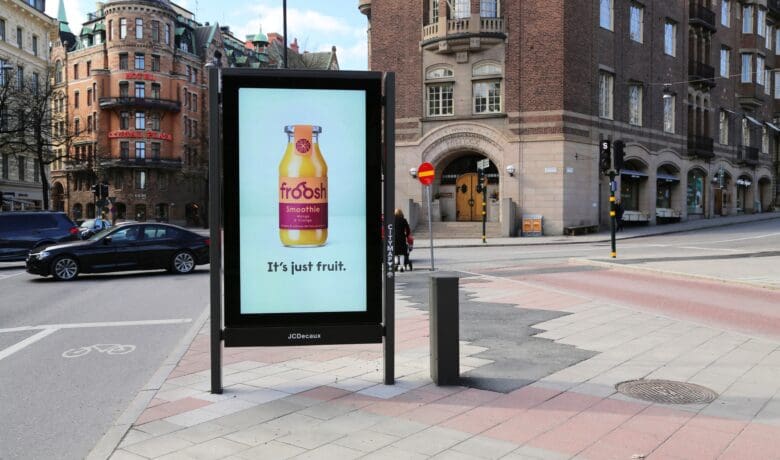
1Keep it simple
On an outdoor poster, you have about 2–3 seconds – so the message has to be crystal clear. Keep the creative to three main components: logo, short copy and image. Campaigns that do this achieve on average 15% higher logo attention than creatives with four elements. Use few words. When a poster contains more than ten words, people become around 30% less likely to remember who the advertiser is.
-
 2
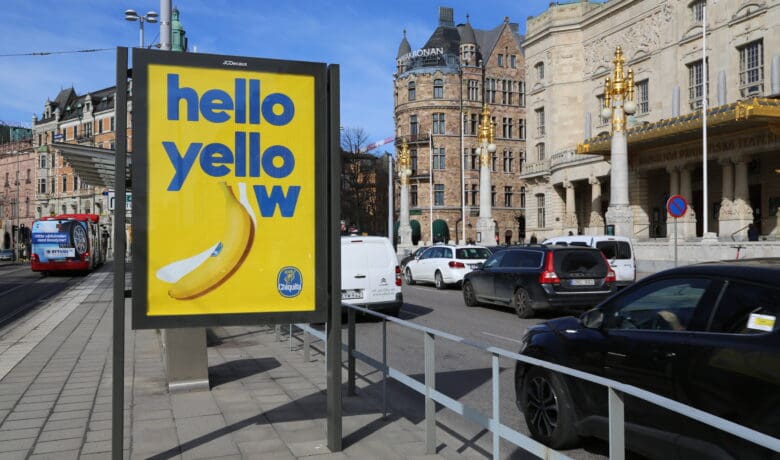
2Show your colours
Colourful creatives drive up to 22% higher emotional impact. When you use a colour that is strongly associated with your brand, both the emotional effect and recognition increase – the viewer more quickly understands who is speaking. Emotions help us remember, so let colour carry both the feeling and the brand.
-
 3
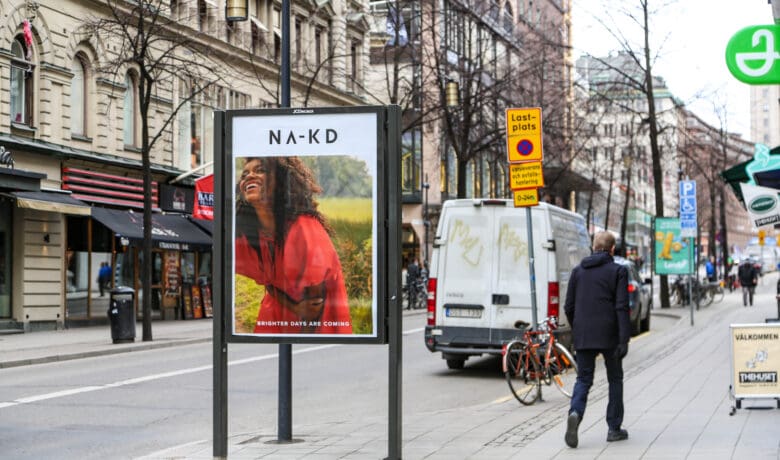
3Upper half – the most important part
We read an outdoor poster centered, from top to bottom. If the sender is placed at the top, you can achieve up to 32% higher recall. To avoid important information being obscured by bikes, cars or people at street level, the key message should be placed in the upper half of the poster. Think: logo, main message and any call to action at the top – supporting information further down.
-
 4
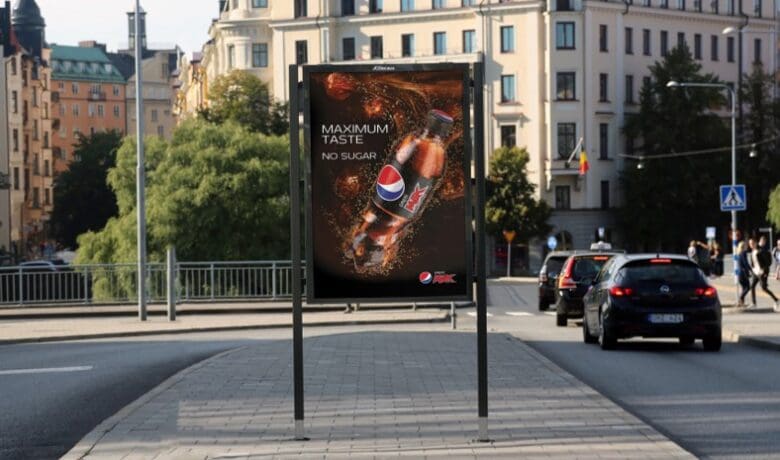
4A picture is worth a thousand words
An image that is clearly linked to your brand makes the creative 33% more impactful in terms of both recognition and emotion. When the product occupies more than 50% of the space, it receives around 38% more attention – on average 2.28 seconds. If the product makes up less than 50% of the creative, it is only looked at for around 1.65 seconds – a big difference when you only have a few seconds in total.
-
 5
5Eye Contact
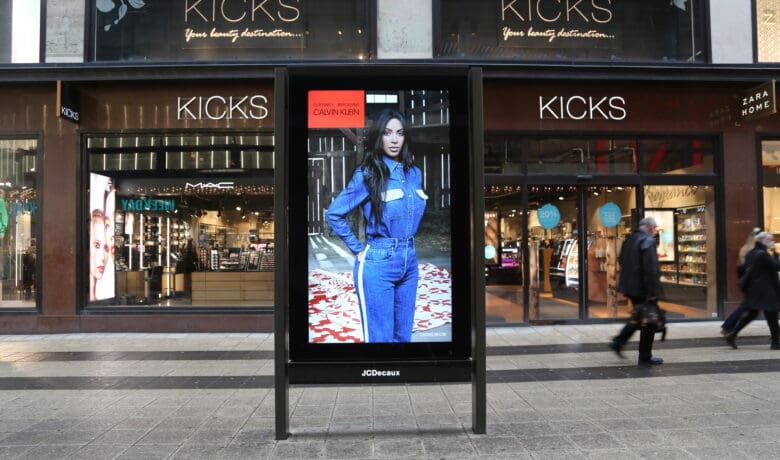
One of the fastest and strongest ways humans communicate is through eye contact – an early and fundamental social function. When eyes meet, emotions are conveyed instantly, and emotions are crucial for memory and recognition. Use faces and clear eye contact in your creatives to create a sense of closeness and make it easier for the audience to remember both the feeling and the brand.
Outdoor School
JCDecaux’s Outdoor School offers practical tips for effective outdoor advertising. The series covers important areas such as logo and sender placement, creative possibilities, messaging and design, trial posting, and the significance of contrasts and color choices. With these tips, you’ll learn to create clear, engaging, and visually impactful campaigns that reach your audience quickly and effectively.
-
Message and Design
with Jonas Bergman -
Innovate
with Jonas Bergman -
Contrasts and Color Choices
with Jonas Bergman -
Logotype and Sender
with Jonas Bergman -
Test your Campaign
with Jonas Bergman
Guidelines
Q&A
What are the advantages of outdoor advertising?
With outdoor advertising, you achieve high frequency at a low contact cost, as your message reaches a large number of people multiple times throughout the campaign period. Outdoor advertising generates a high reach, even within a specific city. The medium is excellent for brand-building advertising as well as promotional advertising. Moreover, outdoor advertising stands out as the last mass medium in an evolving media landscape.
Why choose outdoor advertising?
Outdoor advertising can’t be clicked away, switched off, or muted. It exists where large crowds move. Our outdoor media reach 70% of all Swedes aged 15-79 in the 25 largest cities. If you want to deliver your message quickly to a wide audience, outdoor advertising is the best media choice.
What is frequency?
The number of times an individual has the opportunity to see the campaign on average.
How do you calculate reach?
We calculate reach in two ways: net reach is the number of unique individuals who are reached by the advertising message (an individual can only be counted once), while gross reach is the total number of contacts (an individual can be counted multiple times).
What is OTS (Opportunities to See) and OTH (Opportunities to Hear)
The number of times the average individual in the target audience has the opportunity to encounter the advertising message during a campaign period, on average (total possible contacts with the medium per individual).
Outdoor Glossary
Adshel ClearChannel’s name for a Eurosize format. Common at bus stops and standalone billboards, offering high visibility and frequency in urban environments.
Backlit Lighting on the advertising surface that illuminates the poster from behind during the dark hours of the day.
Gross Price The list price before any discounts.
Distribution The spread of advertising spaces across a region.
DOOH (Digital Out Of Home) Digital outdoor advertising that uses digital screens to display ads, featuring dynamic content based on time, location, and audience data.
Eurosize Outdoor product with dimensions 1185 x 1750 mm, ideal for bus shelters, wall-mounted, and standalone billboards.
Standalone Advertising spaces on streets and squares, offering flexibility in placement and targeting compared to those integrated into bus shelters.
Fullsize Column format measuring 1185 x 3260 mm, designed for maximum visual impact and visibility. No longer sold, and competitors have no equivalent.
Head On The advantageous side of an advertising surface, oriented towards traffic flow for maximum audience contact.
Network Outdoor spaces organized into series for even distribution and coverage in larger cities, offering cost-effective advertising placement.
OBS Surveys Post-campaign evaluation measuring the visibility and impact of the message.
Offset 4+0 Simple printing method, printed on one side of the paper, optimal during seasons with short, long daylight periods.
Offset 4+3 Advanced printing method, printed on both sides of the paper to enhance contrasts, especially useful during dark backlighting periods.
OOH (Out Of Home) Traditional outdoor advertising, includes non-digital signs and posters across various locations.
Outdoor Impact Analysis tool and methodology for generating reach and frequency, optimizing campaign impact and strategy.
Potential Measure Forecast of campaign results and effects before launch, based on Outdoor Impact data.
Preliminary Booking Time-limited reservation of outdoor spaces with a decision required within 48 hours if a location conflict arises. No longer offered.
Select Surface Specially chosen advertising space, separate from larger networks, for focused hyper-local advertising, e.g., a directional space for a shop.
SOV (Share Of Voice) Percentage of outdoor space that a campaign covers, indicating its competitive position.
City Information Public advertising space providing useful community information, strategically placed on standalone signs.
Supersize Large format, backlit surface of 60 sqm at key points like Stockholm’s and Gothenburg’s entrances.
Weather Shelter Synonym for advertising spaces at bus shelters.
Attention Index: Measures how long a viewer remains engaged with the advertisement, particularly relevant for digital screens.
Return on Investment (ROI): Measures the profitability of an investment relative to its cost.
Bounce Rate: The percentage of visitors who leave a website after viewing only one page.
Brand Effect: The effects a campaign has on brand awareness and consumer attitudes.
Gross Reach: The total number of contacts generated by a campaign, where the same person can be counted multiple times.
Conversion Rate: Measures the percentage of visitors who perform a desired action, such as a purchase or subscription.
CPT (Cost Per Thousand Contacts): The cost of reaching a thousand individuals with an advertising message, calculated as net cost divided by the number of contacts times one thousand.
Cost Per Action (CPA): The cost incurred when a user performs a specific action, such as subscribing or registering.
Cost Per Click (CPC): The cost generated each time a user clicks on an ad.
Cost Per Mille (CPM): The cost for displaying the ad a thousand times.
Coverage Rate: The proportion of your target audience covered by the campaign.
Distribution: Allocation and spread of advertising space across different regions.
Engagement Rate: The number of interactions such as likes, shares, and comments relative to total views.
Exposure: The number of times an advertisement is shown on a particular surface, often including multiple display periods or poster exchanges.
Frequency Cap: The limit on how many times an individual user can see the same ad with programmed advertising to prevent overexposure.
Flow: The number of pedestrians and vehicles passing by a specific outdoor advertising space.
Footfall Attribution: Process for determining whether people have visited a location after being exposed to a certain advertisement.
Frequency: How many times an individual sees a particular advertising campaign over a defined period.
Geo-Targeting: The use of location-based technology to display ads to specific regional target audiences.
Gross Rating Point (GRP): Measures the total exposure of the campaign to the target audience, calculated as frequency times reach.
Impressions: The number of times an ad is shown to users, regardless of whether it is noticed or not.
Click-Through Rate (CTR): The percentage of views that result in a click on the ad.
Conversion Rate (CVR): The percentage of visitors who perform a desired action, such as a purchase or registration.
Lift Values: The difference in response between those who saw a campaign and those who did not, to measure campaign effectiveness.
Net Reach: Unique individuals who see your advertising campaign, as opposed to gross reach.
OOH Observation: Value Measurement of how well your outdoor advertising is observed.
Opportunity to See (OTS): The number of people who have the chance to see an advertising space as they pass by.
Opportunity To Contact (OTC): Potential contacts (not guaranteed attention).
Passes: The number of people and vehicles passing by an outdoor advertising space during a given time period.
Potential Measure: Predict the campaign’s potential results before the start, based on analysis tools like Outdoor Impact.
Programmatic Buying: Automation of purchases for digital outdoor advertising based on data and algorithms.
Reach: The number of unique individuals who have observed an ad.
Realistic Opportunity to See (ROTS): Calculation of individuals’ realistic opportunity to observe an advertising space based on site placement.
ROMI (Return on Media Investment): Measures the return on media investments in terms of value and effect.
Reach: The percentage of the target audience influenced by the message in an advertising campaign.
ROAS Return on Ad Spend: Measures revenue generated per advertising currency spent.
Share Of Voice (SOV): Your campaign’s share of total advertising space in a certain category, expressed as a percentage.
Sveriges Annonsörer: “Swedish Advertisers” is an independent interest organization that has existed since 1924, representing the collective interests of Sweden’s marketers. JCDecaux is a terawatt partner.
Sveriges marknadsförbund: The Swedish Marketing Federation is a non-profit interest organization that brings together marketers and communicators.
Traffic Count: Data measuring the number of people or vehicles passing by a particular advertising space, important for assessing exposure.
Visibility Adjusted Contact (VAC): Adjusted contact volume based on how well the advertisement can be seen according to Outdoor Impacts criteria.
Visibility Adjustment Index (VAI): Adjusts reach based on placement, angle, and distance, determining how many have actually noticed the message.
Visibility Adjustment (VA): Assesses the visibility of the advertising surface based on its physical placement, such as facing toward or away from traffic.